Difference between revisions of "4A"
Jump to navigation
Jump to search
| Line 1: | Line 1: | ||
| − | This Amateur Radio | + | This Amateur Radio Transmitter was introduced in the October 1933 issue of QST. |
It is a crystal-controlled CW-only transmitter capable of 20 watts RF output. | It is a crystal-controlled CW-only transmitter capable of 20 watts RF output. | ||
The crystal and associated band-changing coils were plugged from the top of the unit. | The crystal and associated band-changing coils were plugged from the top of the unit. | ||
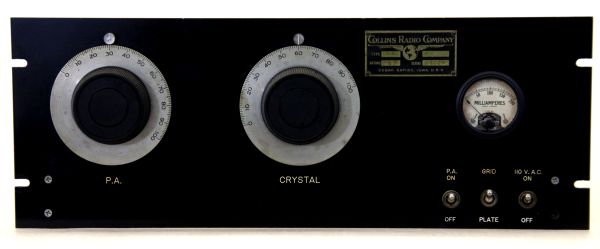
[[File:4A front m.jpg|center|This unit is now in the UTC museum.]] | [[File:4A front m.jpg|center|This unit is now in the UTC museum.]] | ||
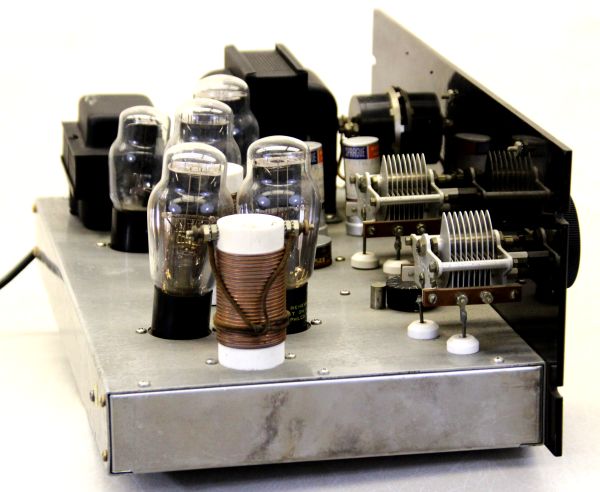
[[File:4A upper-left m.jpg|center|Internal View]] | [[File:4A upper-left m.jpg|center|Internal View]] | ||
| − | The 4A was a kit, all parts included, | + | The 4A was a kit, all parts included, however, you were responsible to purchase the tubes separately. |
| − | ==Construction== | + | == Construction == |
Like many home-assembled projects - this unit had no cover, top, sides or back. | Like many home-assembled projects - this unit had no cover, top, sides or back. | ||
| + | == As Advertised == | ||
Revision as of 23:27, 29 March 2020
This Amateur Radio Transmitter was introduced in the October 1933 issue of QST. It is a crystal-controlled CW-only transmitter capable of 20 watts RF output. The crystal and associated band-changing coils were plugged from the top of the unit.


The 4A was a kit, all parts included, however, you were responsible to purchase the tubes separately.
Construction
Like many home-assembled projects - this unit had no cover, top, sides or back.
